Neurodivergent-Inclusive Design: How The Built Environment Can Work For Every Brain
Omicron Built Environment Intel
Written by Ayla Calverley, RID, NCIDQ & Vera Li, RID, NCIDQ, BDes, WELL AP, LEED AP BD+C, ID+C., Fitwel
1 in 5 people worldwide are neurodivergent. That means in any workplace, school, or public building you design, a significant portion of the people using that space process the world differently. Neurodivergent-inclusive design is not a niche consideration, it is a baseline for spaces that actually perform for the people in them. The core principle is simple, design for choice and control.

What Is Neurodivergence?
Neurodivergence describes the many different ways a brain can learn and process information. It is not one thing. It spans a wide range of cognitive processes, from fast-thinking and verbally expressive, to slow, deep processing that surfaces big ideas over days. The way our brains work isas varied as physical appearance, and that variation is an evolutionary advantage.
Worldwide, 1 in 5 people are neurodivergent and possibly under the following umbrellas:
- Dyslexia: 9–12% of the population
- ADHD (hyperactive, inattentive, combined): ~5% of the population
- Autism Spectrum Disorder: ~1.5% of the population
- Anxiety (generalized and social): 4.4% of the population
- OCD: ~1% of the population
- Other (Tourette syndrome, dyspraxia, dysgraphia, dyscalculia, speech and language disorders): 5–8% of the population
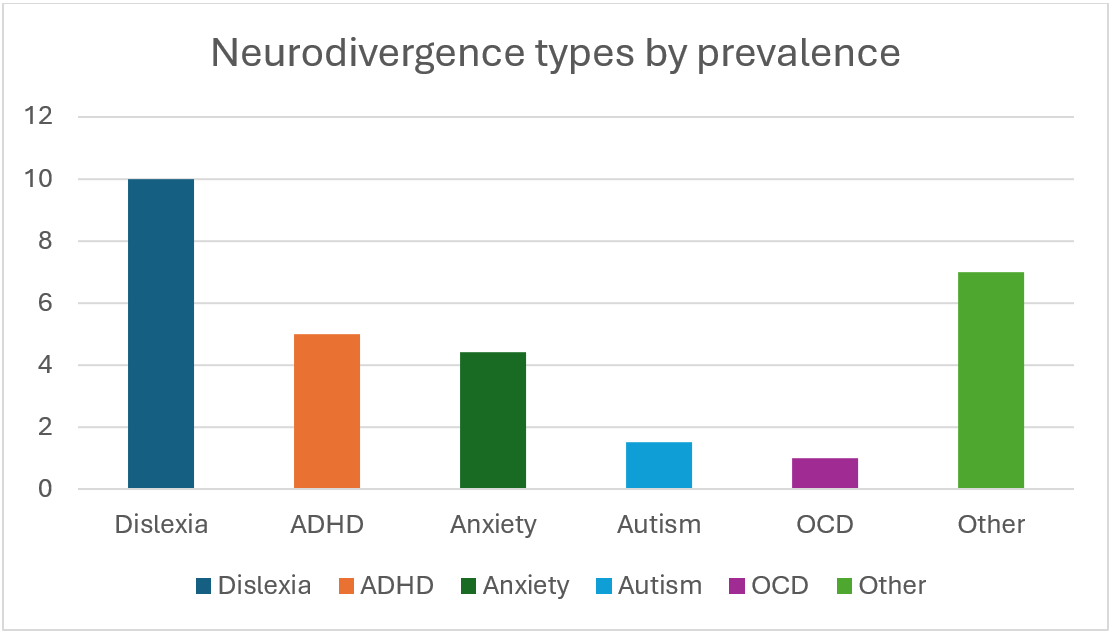
Together, ADHD, dyslexia, and autism spectrum disorder account for 70% of all neurodevelopmental diagnoses. These conditions occur across all levels of ability, culture, language, intelligence, race, and age, and many people live with more than one.
Why Does Interior Design Matter for Neurodivergent People?
Sensory experience directly affects whether a neurodivergent person's strengths or challenges are ‘out front’ on any given day. The built environment is not a neutral backdrop, it is either creating or reducing friction.
Interior designers are already well-practiced at physical accessibility such as designing for wheelchairs and mobility devices, visual and hearing impairments, and other physical needs. Neurological accessibility follows the same logic; the key is to include opportunities for choice and control. When people can decide how, where, and when they engage with a space, they can manage their environment to work with their brain, not against it.
For example, a client’s scope may focus on designing a workplace entry environment that’s perceived as inviting and energetic; entirely open, an active collaborative hub, bustling with colour and sound. This can be genuinely overwhelming for someone with anxiety or sensory sensitivities. By providing alternative points of entry, such as a discreet and low‑stimulus arrival, we can offer individuals the ability to choose how they experience the space.

What Does Neurodivergent-Inclusive Design Actually Look Like in Practice?
The goal is a range of environments within one space, not separate spaces for separate people, but a layered environment where everyone can find what they need. Key strategies include:
Sensory Environment
- Adjustable lighting controls to support different sensitivity levels.
- Acoustic zoning, active, buzzy collaboration areas alongside quiet, calming spaces.
- Olfactory and tactile considerations to reduce unexpected or overwhelming sensory input.
- Restorative elements: biophilic patterns, natural materials, views of nature, calming sounds.
Spatial Layout
- A balance of high-stimulation and low-stimulation zones.
- Both intimate-scale and open-scale environments within the same footprint.
- Symmetrical or asymmetrical spatial organization depending on the desired cognitive effect.
- Clearly defined transitions between activity zones for intuitive navigation and mental clarity.
Colour
- Intentional use of colour to either stimulate, supporting creativity and collaboration, or de-escalate and reduce psychological distress
Space Variety
- A range of room types and sizes to support different workstyles, focus needs, and group sizes.
- Multiple arrival or entry routes where possible, including low-stimulus options.
By offering this range, people can make real choices about how they work and use the space. They can move toward what supports them and away from what does not without having to explain themselves or ask for accommodation.
The principles above are not theoretical. Here is how we applied them.
For Insurance Council of BC, we designed a workspace that balances active and calming zones, with high acoustic separation in private offices for individuals who need heads-down, distraction-free focus. We grounded the palette in plants and natural materials, bringing in restorative elements that reduce sensory load without making the space feel sterile. A variety of bookable space types gives every person a real choice in how and where they work, so control stays with the user, not the floor plan.
It is a straightforward example of what we work toward one very project, not a single solution, but a layered environment where different people can find what they need on any given day.


Does Neurodivergent-Inclusive Design Apply Beyond the Workplace?
Yes. The same principles translate directly to education environments. In schools, reducing sensory input through lighting, colour, and acoustics supports neurodivergent learners in staying regulated and focused. Sensory rooms with adjustable coloured lighting give students a degree of control over their environment, which research shows can reduce symptoms and help de-escalate emotional distress.
The underlying principle is the same in every building type: when people feel in control of their sensory environment, they function better.
How Do Design Standards Like WELL Address Neuro-Inclusion?
WELL v2 actively advocates for neuro-inclusion as part of its community feature framework. The standard recommends:
- Early stakeholder engagement to define neuro-inclusion goals before design begins
- Integrated multisensory design strategies built into the project from the start
- Clear communication about how spaces are intended to be used
- Educational programming to ensure neuro-inclusive spaces are understood and properly supported over time
WELL v2 reflects a broader shift in the industry: neuro-inclusion is no longer optional or aspirational, it is becoming a standard of practice.

The Omicron Perspective
Designing for neurodivergence is not about adding a quiet room at the end of a project and calling it inclusive. It is about understanding, from the very start, that the people using a space will experience it in fundamentally different ways.
That means making real decisions about acoustics, lighting, colour, and spatial variety, not as aesthetic choices, but as functional ones. It means building in arrival options, transition zones, and sensory balance so that a person managing anxiety, ADHD, or sensory sensitivity can navigate a space without friction. It means looking at a floor plan and asking "does this give people enough control over how they experience it?"
At Omicron, we bring this lens to every interior design project we work on. During the strategy and programming phase, we engage with end-users early to understand the full how people in that organization think, work, and move through space. That insight shapes the space typology and layout, material selection, lighting specification, and acoustic zoning. Our integrated model means those decisions are carried through design and into construction without getting lost in a handoff.
The goal is always the same: spaces that work for everyone who uses them, not just the majority.
Omicron Built Environment Intel
Written by Ayla Calverley, RID, NCIDQ & Vera Li RID, NCIDQ, BDes, WELL AP, LEED AP BD+C, ID+C., Fitwel
Learn more about our Interior Design Services: omicronaec.com/interior-design