Beyond the RFP: Why Relationships Still Build the Best Projects
Steele Jordan Vice President, Business Development — In the integrated architecture, engineering, construction, and development world, we regularly find ourselves in the familiar rhythm of responding to Request for Proposals (RFPs) and Request for Quotes (RFQs). It’s become the norm, a structured process meant to ensure fairness, competitiveness, and consistency across the bidding landscape.
But after years of watching how these processes play out, it’s worth asking: are RFPs and RFQs still serving the outcomes the industry genuinely values or have they quietly shifted from selection tools to efficiency mechanisms that emphasize price over partnership?
Where RFPs Were Meant to Help
RFPs emerged from a good place, which is an attempt to make project selection transparent and equitable. Clients wanted clear comparisons, standardized criteria, and ways to mitigate bias. For public institutions and large private developers, they became the preferred method of maintaining accountability and due diligence.
And to a point, those goals are still valid. But when the process becomes entirely transactional, something essential gets lost.
The Problem With Price-Centric Scoring
It’s no secret that in many RFP evaluations, the lowest fee wins. Over time and within the current environment, this practice has quietly corroded what should be a qualifications-based process into a commoditized race to the bottom.
The results are predictable:
- Reduced scope or design quality.
- Under-allocated time and resourcing on complex deliverables.
- Partnerships that start strained because they were never aligned through meaningful interaction.
Real estate creation is not a commodity, it’s a personality. Each project has its own rhythm, culture, and creative chemistry. Selecting a partner based largely on price is like choosing a dance partner without ever stepping on the floor together.
Why Face Time Still Matters
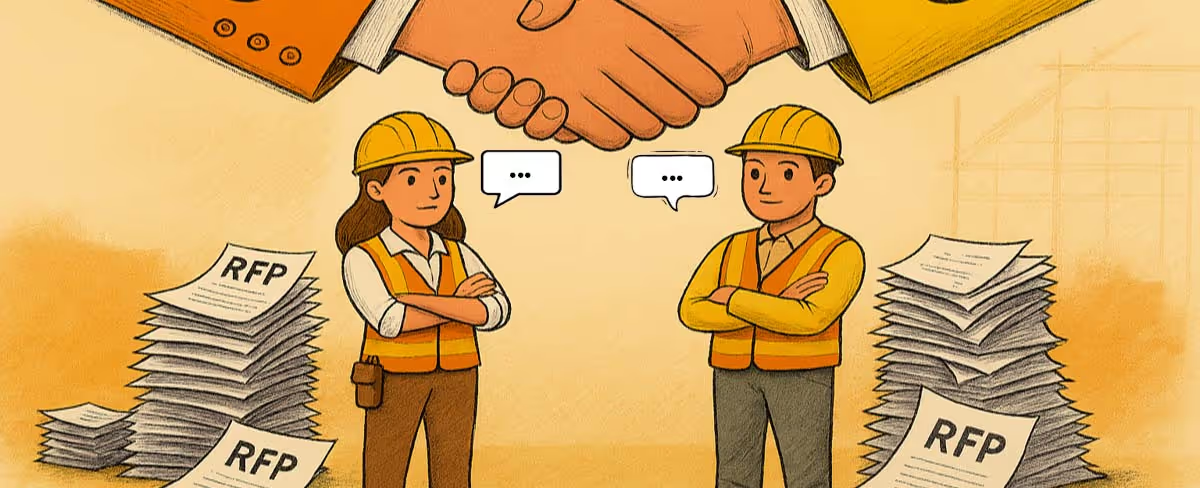
A faceless RFP process without interviews or conversations doesn’t dig deep enough to uncover alignment in this complex environment. It can’t measure trust. It can’t sense chemistry. It can’t spot how teams think, react, or communicate.
Interviews can help bring projects to life. They allow both sides to understand the project’s true personality; what makes it tick and what it will take to deliver it successfully. That conversation often reveals qualities no written proposal ever could such as adaptability, integrity, curiosity, and shared purpose. Basic, respectful dialogue.
Shaping a Better Path Forward
If the industry wants more resilient projects and stronger results, procurement processes must evolve. Some simple, practical steps can help restore balance:
- Always include an interview component for shortlisted teams.
- Separate technical and financial proposals or gates to let qualifications lead the first phase of assessment. Something we have noticed more of, as of late.
- Weigh collaboration and approach as heavily as cost.
- Hold meaningful debriefs - positive or negative - so every participant grows through the process.
RFPs and RFQs will probably always be part of our industry. But when they become purely mechanical, they fail to reflect what actually drives successful projects: relationships, shared vision, and trust built through dialogue.